
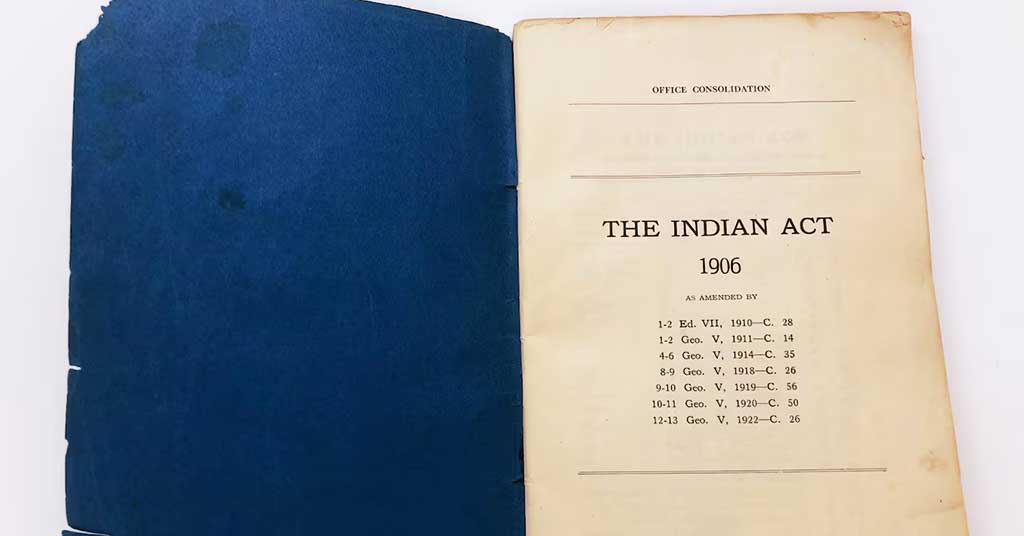
The Indian Act was meant to be temporary, but instead created a permanent legal divide that should be abolished
While only one per cent of the Canadian population lives on Indian reserves, that tiny population is constantly in the news. From court cases that pit Aboriginal title against established property rights to First Nations challenging Alberta’s independence referendum process, their increasingly aggressive demands fill our courtrooms and newspapers.
All of this flows from one statute passed early on: the Indian Act, which creates a system for reserve residents that is very different from the rules and laws that apply to everyone else. It is regarded as a relic of the past, but attempts to get rid of it over the years have all failed.
Why did we need it?
The foundation of the Indian Act was the Gradual Civilization Act of 1857, which was itself based on recommendations from the 1844 Bagot Commission. Until that time, the colonial government had treated Indians only as tribes. During early colonization, when the French and British were fighting for control of the continent, this made sense. The various tribes allied with them in ways that suited each party’s agendas.
But as the fur trade waned and settlers began arriving, it was clear that Indians would have to adapt to the white man’s world. This would not be easily accomplished. Indians of the Northwest had resided from 1670 to 1870 mainly within Rupert’s Land, which offered virtually nothing to the inhabitants in the way of government or educational opportunities. Worse still, disease, intertribal warfare and whisky had decimated the small, scattered Indian population.
Canada’s founders concluded that the only solution to what was even then known as “the Indian Problem” was to place Indians in a special legal category as registered or “status” Indians. They were made “wards in tutelage,” similar to children in school, and placed on reserves, where they would be temporarily protected and educated before being left to fend for themselves.
But not all Indians were made “status” Indians. An Indian who graduated from university or entered certain professions could automatically lose his status through enfranchisement. The thinking was simple: he was presumed to be literate, capable and independent.
It’s necessary to look at the terms “assimilation” and “enfranchisement” because they are both largely misunderstood.
First of all, “assimilation” does not necessarily mean “forced assimilation.” Indians could choose to become ordinary Canadian citizens through “enfranchisement,” although the law also forced enfranchisement in some circumstances. Another term for “assimilation” is “integration.” That was the same policy applied to all of the settlers arriving in Canada from different parts of the world. Both settlers and Indians were free to keep as much as they wanted of their culture and ethnic identity.
The next step was for the Indians to gradually become part of mainstream Canadian society by a process called “enfranchisement.” The term “enfranchisement” is associated with voting. But it meant much more. An Indian choosing to be enfranchised was eligible to receive a per capita share of his band’s trust funds and an allotment of 50 acres of reserve land in fee simple. He could stay on his reserve or sell his land to an Indigenous or non-Indigenous purchaser and move off the reserve.
Reserves would gradually morph into stand-alone municipalities or merge with existing ones. In time, the reasons for a separate Indian system would disappear. Indians would be Canadian citizens with equal individual rights. Tribal rights would be a thing of the past.
It didn’t work out that way.
The federal government made the enfranchisement process unnecessarily complicated. More importantly, the chiefs did not want to see their band proceeds and reserve lands devolve to individuals, so those desperate to find a better life off reserve left with nothing.
They arrived in cities completely unprepared for modern life. A short walk north on Winnipeg’s Main Street graphically reveals the results.
The myth that enfranchisement failed because Indians wanted to hold on to their culture is false. According to the 2021 census, 59.4 per cent of First Nations people with Registered or Treaty Indian status lived off reserve. They left because reserve culture had given them nothing. They would gladly have accepted an enfranchisement that would have put some money in their pockets.
But enfranchisement failed. So the vision of our founders—that the separate Indian system would naturally come to an end—did not happen. A race-based system that was meant to offer temporary protection has now become entrenched.
Attempts by the federal government to restore the founders’ vision, most notably the 1969 White Paper, were successfully resisted by the chiefs.
Our courts and governments since then have seemed intent on preserving the separate First Nations system. It is time to reverse course. The Indian Act has outlived its purpose and should be abolished.
Brian Giesbrecht is a retired Manitoba Provincial Court judge and Senior Fellow at the Frontier Centre for Public Policy. Drawing on three decades of judicial experience, he provides expert analysis on Canadian legal trends, social policy, and justice reform, advocating for evidence-based policymaking.
Explore more on Aboriginal Politics, Aboriginal Canadians, Rights and Responsibilities
The views, opinions, and positions expressed by our columnists and contributors are solely their own and do not necessarily reflect those of our publication.
Troy Media empowers Canadian community news outlets by providing independent, insightful analysis and commentary. Our mission is to support local media in helping Canadians stay informed and engaged by delivering reliable content that strengthens community connections and deepens understanding across the country.

