
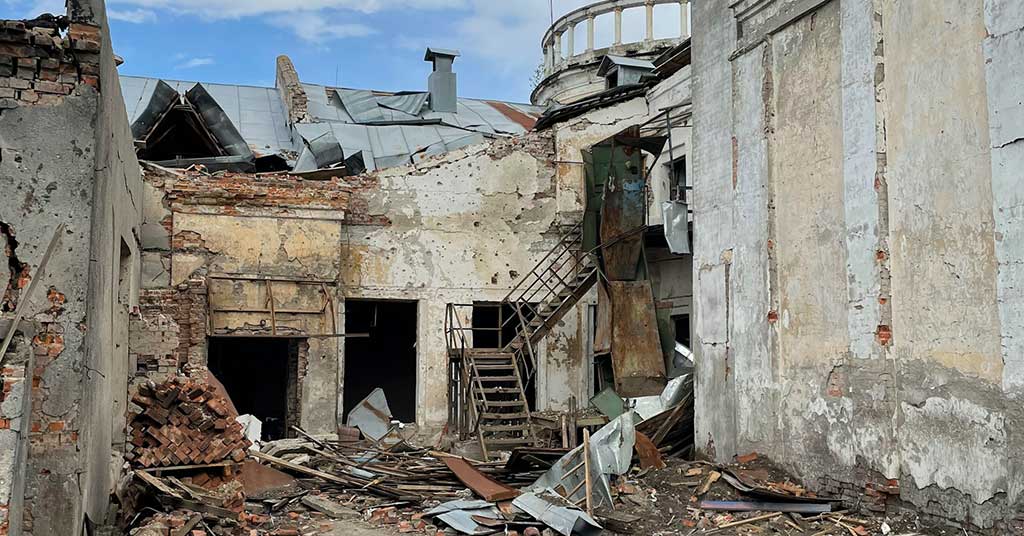
More than 10 million Ukrainians still need humanitarian aid as global attention fades
Four years after Russia launched its full-scale invasion, Ukraine is still facing a massive humanitarian crisis, even as the war has gradually slipped from the world’s attention.
For Canadians, the war can sometimes seem distant now. Other conflicts, political upheavals and crises compete for our attention. But for Ukrainians, there is no changing the channel. Fathers are still being killed or severely wounded on the front lines, mothers are holding families together and children are growing up surrounded by fear, displacement and loss.
The numbers alone should shake us out of any sense that the crisis has passed.
“The scale of suffering remains staggering. An estimated 10.8 million people across Ukraine are still in urgent need of humanitarian assistance. Another million in the Russian-occupied parts of Ukraine also need support. Some 3.7 million people remain internally displaced, and nearly six million have sought refuge abroad,” wrote Matthias Schmale, resident and humanitarian coordinator for Ukraine, in a UN statement marking the fourth anniversary of the full-scale invasion in February.
Yet behind those numbers is a humanitarian crisis that has not disappeared simply because Ukraine receives less attention today. Anastasiia Hryniuk, who runs the Ukraine program for the Catholic Near East Welfare Association (CNEWA), a Catholic humanitarian agency that works through local church partners, witnessed the human reality behind those numbers during a recent visit to Ukraine.
“Ukrainians are living in a state of uncertainty and fear that’s hard for Canadians to imagine,” she told me. “Ukrainians don’t know from one day to the next if there will be another bombardment or get bad news about a loved one on the front line, which could upend their lives forever. War has become part of their daily lives.”
Yet Hryniuk also witnessed something that statistics cannot capture: the enduring faith, hope and resilience of people who refuse to allow war to define everything about their lives. Despite the daily stress of living in a country under attack, Ukrainians continue working, caring for their families, worshipping and hoping for peace.
For many, the Church has become an important source of both spiritual and practical support.
“The Church is a refuge and sanctuary for the people, and CNEWA works in close partnership with the Ukrainian Greek Catholic Church to bring some relief and hope to the suffering people of Ukraine,” Hryniuk said. Caritas Ukraine is another CNEWA partner.
Much of that support is directed toward families bearing the consequences of war.
“War takes a huge toll on families,” Hryniuk said. “And to the Catholic Church, families are fundamental.”
She saw mothers carrying the responsibilities of family life while praying their husbands would return. Even when they do, the war may come home with them.
“Even if he does, he is often beyond recognition because of the effects of PTSD (post-traumatic stress disorder),” she said. “The experience of war changes these men and it’s difficult for them to adjust to normal domestic life.”
The physical and psychological wounds are accumulating, creating needs that will continue long after individual battles have ended.
At the Ukrainian Catholic University in Lviv, CNEWA supports a medical clinic and rehabilitation centre providing specialized care and psychological support for veterans, military personnel and families affected by the war. It also trains future physiotherapists, occupational therapists and psychologists, professionals whose expertise Ukraine desperately needs.
But Hryniuk found more than medical care there.
“The place is filled with Christian love. The chapels in every building of the university are filled with people singing and praying for Ukraine. It’s incredibly moving.”
That same combination of practical help and spiritual support extends to other CNEWA projects. CNEWA and its partners support children and adults with disabilities, displaced families and homeless young women vulnerable to human trafficking. Since the beginning of the full-scale war in February 2022, the CNEWA-supported House of Mercy for the Disabled has also provided shelter to hundreds of people displaced by the fighting.
For the people receiving that help, the difference is immediate: rehabilitation for a wounded veteran, shelter for someone driven from home and protection for people made more vulnerable by war.
“Since February 2022, CNEWA Canada has delivered $10.4 million in aid through our trusted partners,” said Adriana Bara, CNEWA’s Canadian director. “With the war dragging on, needs remain acute, particularly around psychological support and community resilience.”
Perhaps nothing demonstrates the human cost more starkly than the children it has left behind.
During a visit to the Orphan Care Centre in Lviv, Hryniuk met a woman caring for a sister and brother from eastern Ukraine who had lost both parents.
“Without CNEWA’s support, we couldn’t do this,” the woman told her.
It is easy to become numb to war after four years. The casualty figures become numbers. Another missile attack becomes another headline. Another destroyed building becomes another image among thousands we have already seen.
That is precisely why we cannot allow war fatigue to become indifference.
Canadians have already shown extraordinary generosity toward Ukrainians. But compassion cannot depend on how often a war appears on the evening news.
For millions of Ukrainians, this war is not yesterday’s story. It is the bombardment they may hear tonight, the husband or son who may not come home, the trauma carried by a returning soldier and the children learning to live without their parents.
They still need humanitarian assistance and continued support. Canadians who are able to help can continue supporting organizations working on the ground. And, as Hryniuk witnessed throughout Ukraine, people draw strength from knowing they have not been forgotten.
For Christians, there is also an obligation that transcends headlines and geopolitics: to remember those who suffer, to offer help where we can and to pray for peace.
Ukraine may no longer command the world’s attention as it once did. But the suffering continues, and its people should not be forgotten.
Susan Korah is an award-winning Canadian journalist and the Ottawa correspondent for The Catholic Register. A recognized expert on human rights, religious persecution, and federal policy, she was awarded the King Charles III Coronation Medal in recognition of her dedicated reporting on these critical issues.
Explore more on War/Conflict, Charity, Christianity
The views, opinions, and positions expressed by our columnists and contributors are solely their own and do not necessarily reflect those of our publication.
Troy Media empowers Canadian community news outlets by providing independent, insightful analysis and commentary. Our mission is to support local media in helping Canadians stay informed and engaged by delivering reliable content that strengthens community connections and deepens understanding across the country.

