
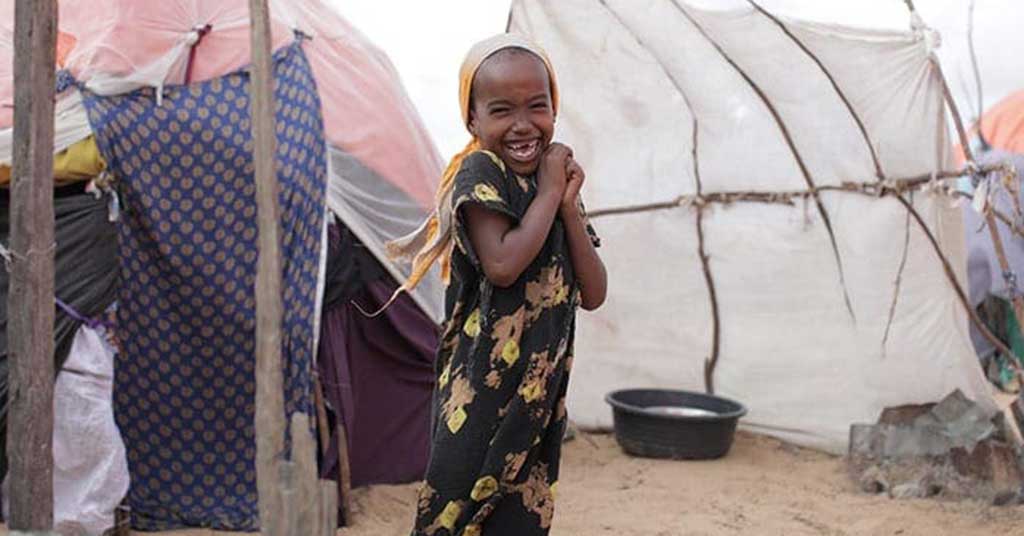
Canadian-backed relief teams are feeding children and fighting disease where global help has all but vanished

For interview requests, click here
As civil war and climate disasters push millions in Sudan and Somalia to the brink of starvation, Canadian compassion is keeping hope alive.
Through church-based partners like Development and Peace–Caritas Canada (D&P) and the Canadian Foodgrains Bank, Canadian donors are providing life-saving food and aid to millions in countries torn by war and devastated by drought and floods. The two Canadian organizations pool donations from churches and individuals nationwide, working with partners like Trocaire (pronounced “throw-kara”) to deliver food and medical supplies directly to local communities.
The Irish wing of Caritas International and a long-time D&P partner, Trocaire channels that compassion on the ground. The organization’s name itself means “compassion” in Irish, and its mission is to deliver relief where suffering is often unimaginable and underreported.
Mary Wamayu, Trocaire’s country director in Sudan, and her counterpart, Europe Maalim, with Trocaire Somalia, were recently on a whirlwind visit to Canada to apprise Canadians of the devastating consequences of civil war in Sudan and climate disasters in Somalia, to thank Canadian supporters, and to address the Canadian Conference for Global Health in Halifax.
A surge of social media posts and news headlines has turned the world’s gaze briefly away from Gaza and Ukraine to Sudan, a sub-Saharan African country that shares a border with Egypt to the north and faces Saudi Arabia across the Red Sea to the east.
Since April 2023, Sudan has been engulfed in a brutal conflict between the national army and a powerful paramilitary force, driving what the UN calls the world’s largest displacement crisis. The headlines were triggered by the capture of El Fasher, a city in Darfur, by the Rapid Support Forces (RSF), a Sudanese paramilitary force engaged in a deadly power struggle with the Sudanese Armed Forces.
At a Caritas Internationalis conference in Rome on Oct. 22, UN special rapporteur for food security Michael Fakhri stated: “The conflict in Sudan is worsening and has become one of the largest starvation campaigns in modern history, with both sides using hunger as a weapon.”
Wamayu witnesses this reality on the ground every day and painted a bleak picture of the situation in Sudan, where the deadly civil war brings daily reports of mass slaughters, forced displacement and famine. The United Nations estimates approximately 40,000 people have been killed in the fighting, but the number of dead could be far higher, as a peace plan proposed by the U.S., Saudi Arabia, Egypt and the United Arab Emirates has yet to yield concrete results. There is no end to the war in sight.
One of the most heartbreaking consequences is the acute hunger suffered by children, Wamayu said, adding that in the displacement camps, cholera and other deadly diseases are rampant, exacerbated by a lack of water, sanitation and exhaustion from multiple displacements.
“Imagine a mother trying to feed her baby on a porridge made with the bark of trees ground into powder and mixed with a little flour,” Wamayu told me.
She said pleas for food ring constantly in her ears as she and her staff of seven work with local organizations to address the most pressing needs of her people.
“They need food, not money, as giving money to them wouldn’t help in any way. The shops are closed and there is no food in them.”
On Nov. 2, Pope Francis referred to Sudan’s tragedy and issued a call to the international community to intervene “decisively and generously to offer assistance and support those who are working on the ground to bring relief.”
Canadians have responded magnificently, Wamayu said, providing $1.26 million through donations to D&P and the Foodgrains Bank in the last two years.
“With Canadian help, we have been able to implement a nutritional program for children,” she said. “We have been able to procure sealed sachets of baby food from countries like France and India, arrange transportation and ensure the food reaches the children who need it.”
Last year, Trocaire Sudan treated 4,612 children for acute malnutrition, with hopes to increase that number to 9,000 this year.
“Without that intervention, these children were seven times more likely to die than healthy children.”
Wamayu and her staff deliver the aid in extraordinarily challenging circumstances.
“We no longer feel safe because of the possibility of drone attacks even in the relatively safe area in the Nuba Mountains,” she said, adding that poor infrastructure makes it difficult to reach faraway communities where help is most needed. “Even staff who lost their salaries after USAID budget cuts have stayed on because the need is so great.”
While Sudan remains mired in civil war, Somalia faces a different but equally devastating crisis.
In Somalia, the situation is different but the needs are just as urgent, said Maalim. Pastoralist communities that rely on livestock like goats, sheep, camels and cattle for their livelihood make up a significant portion of the population and contribute about 40 per cent of the country’s GDP, but droughts and floods are taking their toll, with lost livelihoods, starvation and outbreaks of diphtheria and other contagious diseases. Years of severe drought followed by catastrophic floods have left entire rural communities destitute, forcing families to move in search of food and water.
Through D&P, aid is bringing relief to millions.
“Canadians have been major donors of Trocaire Somalia since 2017,” Maalim said. “Through their generous support, we are able to help 1.8 million malnourished kids and implement capacity-building programs to train local health-care workers.”
In both Sudan and Somalia, the message from Trocaire’s leaders is the same: Canadian generosity is keeping hope alive.
For millions facing hunger and displacement, that support means more than aid. It means survival.
Susan Korah is Ottawa correspondent for The Catholic Register, a Troy Media Editorial Content Provider Partner.
Explore more on Foreign Aid, Charity, Human Rights, Poverty, War/Conflict
The views, opinions, and positions expressed by our columnists and contributors are solely their own and do not necessarily reflect those of our publication.
Troy Media empowers Canadian community news outlets by providing independent, insightful analysis and commentary. Our mission is to support local media in helping Canadians stay informed and engaged by delivering reliable content that strengthens community connections and deepens understanding across the country.

