
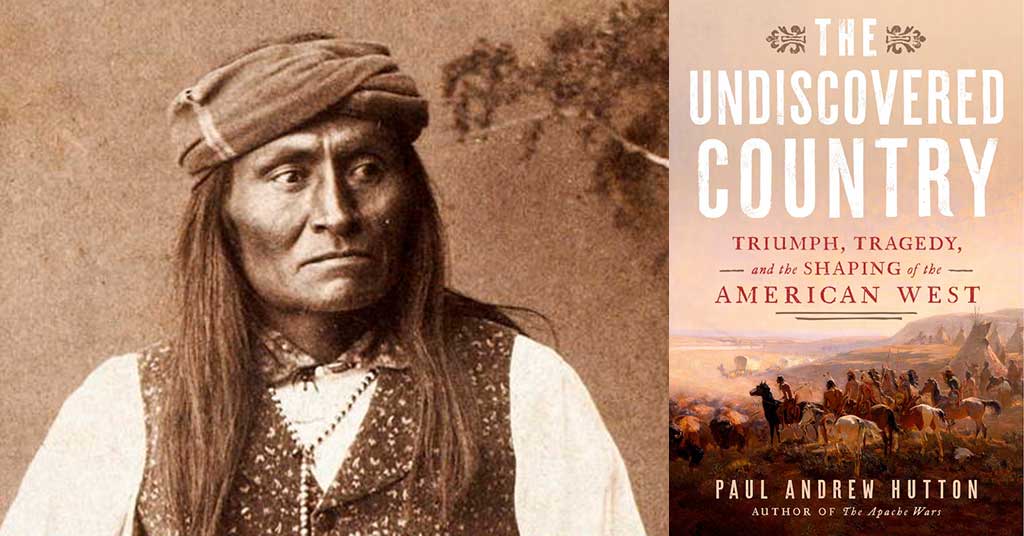
Mangas Coloradas united a warrior nation, sought peace and paid for it with his life. A new book sets the record straight
Title: The Undiscovered Country
Author: Paul Andrew Hutton
Publisher: Penguin Random House
Publication Year: 2025
Available from Amazon

Historian Paul Andrew Hutton’s latest, The Undiscovered Country, reframes the American West through the eyes of seven very different individuals. Three of them, Daniel Boone, Davy Crockett and Kit Carson, are household names in frontier mythology. A fourth, William F. Cody, aka Buffalo Bill, traded in bullets for box office and turned the Wild West into a travelling spectacle.
But it’s the other three who give this book its edge: Red Eagle, Sitting Bull and Mangas Coloradas, Indigenous leaders who resisted, endured and were ultimately betrayed.
As the acclaimed author of The Apache Wars (2016), Hutton has a particular affinity for that aspect of the story. And his narration makes you realize how popular movies didn’t do full justice to the stature of Mangas Coloradas. Released in 1952, The Battle at Apache Pass presents a fictionalized version of that historical event, depicting a sympathetically noble Cochise and a villainous Geronimo. Although Mangas was the senior Apache leader in the real battle, the movie has no such character.
After being pushed westward by their Comanche enemies, the Apaches became the dominant Native American grouping in what’s often described as Apacheria, a vast, sparsely populated area encompassing the modern states of New Mexico and Arizona, plus parts of Northern Mexico.
Hutton describes them this way: “Although united by language, custom and religion as Apaches, these groups lived in proud isolation, with loyalty given first to family and clan rather than to the tribe. At the time of the rise of Mangas Coloradas, the Apache people numbered between 8,000 and 10,000.”
The warrior ethos was a big part of Apache culture and raiding their neighbours was inherent to their way of life. Although sometimes the targets were other tribes like the Navajos, the Spanish-speaking settlers that we’d now call Mexicans were especially attractive prey.
Raiding and war were conceptually different. Although people sometimes got killed during a raid, that wasn’t the primary objective. War, though, was another matter entirely. There, the Apaches were lethal and merciless.
Born circa 1790, Mangas was of racially mixed ancestry. His father was a Chiricahua Apache and his mother was a Spanish captive. He’s described as physically imposing, well over six feet in height. And he often made a positive impression on American emissaries.
But after the 1837 massacre of an Apache village, he acquired an undying enmity for Mexicans. As he reputedly told military surgeon Dr. Michael Steck: “the Spanish and Mexicans had treated them badly … they would kill them and rob them as long as they lived.” This created some issues when the United States and Mexico regularized borders, one part of the deal being that the Americans would prevent Apache raids into Mexico. To the Apaches, the border was merely a line on paper that had nothing to do with them.
Mangas was special in a couple of respects. He was the only one capable of uniting the various clans, and his fundamental disposition was to find a way to get along with the Americans while still protecting key Apache interests. But this delicate balancing act began to fall apart in the early 1850s.
The initial flashpoint had to do with the border commitments to Mexico, and two related incidents of the Americans intervening to rescue captured Mexicans and return them to their families. The first involved Inez Gonzales, a fifteen-year-old Mexican girl that the Apaches had taken in a raid and subsequently sold. The second involved two young Mexican boys who sought and received American sanctuary.
The Apaches weren’t bothered about the girl who was no longer their property when rescued. But the boys were a different matter. Although they eventually settled for compensation in the form of trade goods, the incident rankled.
Soon, other developments heralded the beginning of the end.
The 1854 Gadsden Purchase saw the Americans acquire another chunk of Northern Mexico, just shy of 30,000 square miles. Now, the Apache mountain strongholds were all part of the contiguous United States and thus subject to American jurisdiction. And the 1860 discovery of gold brought an influx of American prospectors who had little regard for Apache prerogatives.
However reluctantly, Mangas was caught up in the inevitable conflict. But after being severely wounded at the Battle of Apache Pass, he grew tired of it all and sought a peaceful settlement, only to be betrayed and murdered in a January 1863 revenge killing orchestrated by an American general.
The Apache Wars dragged on for another 23 years, characterized by atrocities on both sides. However, given the vast discrepancies in numbers and military technology, the ultimate result was never in doubt. After making peace in 1872, Cochise died from stomach cancer in 1874. And Geronimo finally surrendered in 1886.
Perhaps because of his longevity—he died in 1909—it was Geronimo who subsequently became emblematic of Apache resistance, and also something of a celebrity. Beginning with the Trans-Mississippi International Exposition of 1898, he launched on a series of popular public appearances that included the Pan American Exposition of 1901 and the Louisiana Purchase Exposition of 1904. He even collaborated on his autobiography. And, while still technically a prisoner of war, he marched in the 1905 inaugural parade for Theodore Roosevelt.
But historian Robert M. Utley has no doubts as to relative stature: “Mangas Coloradas was simply the greatest of all Apache chiefs.”
Our Verdict: ★★★★☆
Hutton’s book is richly researched and reads with the vivid pacing of an epic. While it occasionally leans a bit reverential, it sets the record straight on Mangas Coloradas and places Apache leadership where it belongs, front and centre. A must-read for anyone tired of dime-store cowboy history.
Troy Media columnist Pat Murphy casts a history buff’s eye at the goings-on in our world. Never cynical – well, perhaps a little bit.
Explore more on History, Legends, Non-fiction books, History books
The views, opinions, and positions expressed by our columnists and contributors are solely their own and do not necessarily reflect those of our publication.
Troy Media empowers Canadian community news outlets by providing independent, insightful analysis and commentary. Our mission is to support local media in helping Canadians stay informed and engaged by delivering reliable content that strengthens community connections and deepens understanding across the country.

