
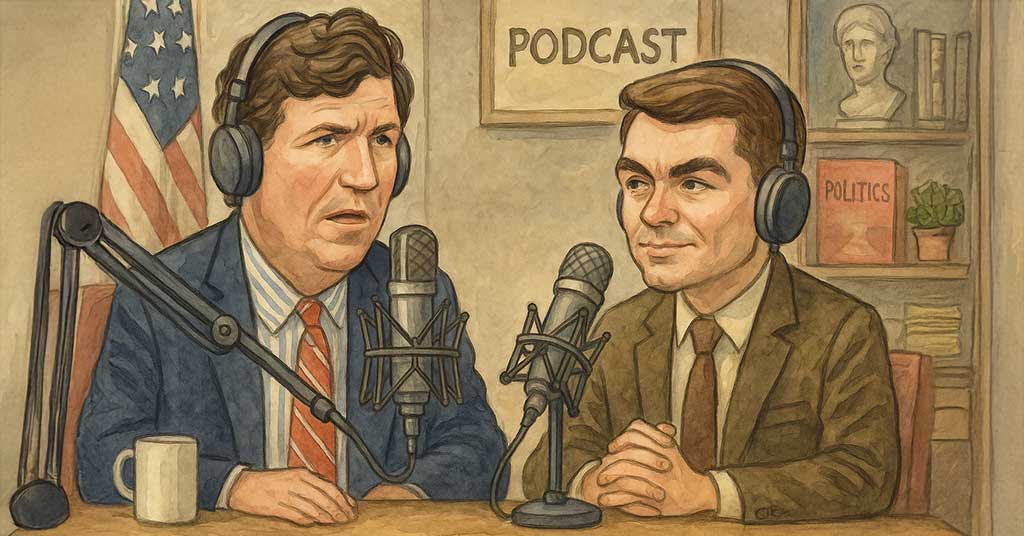
The Tucker Carlson interview with the white nationalist exposes a deeper crisis inside the U.S. conservative movement

A not-so-insignificant number of U.S. conservatives have been having the equivalent of a mini-civil war over the past week. It’s become a battle for the heart, soul and electability of the Republican Party and conservative political movement in general.
The starting point of this right-leaning family feud (of sorts) can be traced back to an Oct. 27 interview between Tucker Carlson and Nick Fuentes.
Carlson is a well-known personality inside and outside the U.S. He’s worked for The Weekly Standard, co-founded The Daily Caller and been a political commentator on radio and TV for decades. He’s also been a host of several popular political shows: CNN’s Crossfire, MSNBC’s Tucker and Fox News’s Tucker Carlson Tonight.
Carlson’s last show was cancelled in 2023 after being named in the high-profile Dominion Voting Systems v. Fox News Network defamation lawsuit. He went on to briefly host Tucker on X, rebranded from Tucker on Twitter, which earned tens of millions of views per show.
This led to his most recent endeavour, The Tucker Carlson Show, a podcast available on audio and video on his streaming service, Tucker Carlson Network, which has become a huge success since it began last May.
Fuentes wasn’t widely known outside of political circles until more recently. The 27-year-old, who is part Mexican through his father, grew up in a middle-class setting in La Grange Park, Illinois. He reportedly started off as a mainstream conservative with an interest in libertarian economics and became a political commentator on radio and TV.
He dropped out of Boston University after receiving death threats for attending the Unite the Right rally in 2017, which had attracted various far-right, white nationalist, white supremacist and neo-Nazi marchers. Fuentes said that he didn’t support Nazism and didn’t defend the individual who drove into a crowd of protesters and killed one woman and injured 35 others.
Nevertheless, he was proud of attending the rally and believed the violence from counter-protesters wholly justified the violence from the marchers.
This, in effect, started Fuentes’s unconventional media career. While largely supportive of U.S. President Donald Trump’s MAGA (Make America Great Again) movement over the years, he also espoused offensive and bigoted ideas related to Jews, Israel, women, gay people, minorities, and more. (There’s a litany of clips on the internet.)
His livestream on Rumble has gained in popularity. He had a widely discussed 2022 dinner at Mar-a-Lago with Trump and controversial rapper Kanye West. He’s assembled a group of followers and fans called Groypers, a variant of the internet meme Pepe the Frog, which seems to have some social media influence based on Fuentes’s significant following.
Why did this interview take place?
It seemed unlikely well into this year. Fuentes had largely been excommunicated from Republican and conservative circles in the past decade. He was seen as “too radioactive,” as The Atlantic put it, since he had “praised Hitler on multiple occasions, likened ‘organized Jewry’ to a ‘transnational gang,’ and said that Chicago is ‘nigger hell.’”
The two political commentators had also been sniping at one another for some time. Carlson had “likened Fuentes to David Duke, the former Ku Klux Klan leader, and accused Fuentes of being part of a campaign to say the most bigoted things possible to make the rest of the right look bad.”
He even called Fuentes a “weird little gay kid living in his basement in Chicago” during an August podcast interview with another controversial U.S. conservative commentator, Candace Owens. (Carlson apologized for this during last week’s interview.)
The political battleground has changed since the horrific assassination of U.S. conservative activist Charlie Kirk on Sept. 10. The importance of free speech and intellectual discourse has always been promoted by right-leaning individuals and groups. Yet there’s been more of a willingness for disparate individuals to speak with one another.
Carlson has been among the leaders of this particular charge. His views used to be more mainstream, but he’s shifted in certain respects—and converged at times with Fuentes. He has more skepticism about U.S. foreign policy and military intervention. He’s taken a positive approach to Vladimir Putin’s Russia. He’s been critical when it comes to Israel and its campaign in the Gaza war. His frustration with everything from neoconservatives to, as the Fuentes interview revealed, Christian Zionists has increased.
Some have argued that Carlson’s interview with Fuentes was an attempt to sanitize the latter’s views and make them more palatable. That’s difficult to say with certainty. What is true is that Fuentes’s appearance gave him more public exposure than ever before. He’s well spoken and more polished than he was years ago. This helped clean up his previous messaging, aided by Carlson’s decades of media experience and ability to control the flow of conversation. It wasn’t a hard-hitting interview, but it served both their purposes.
Here’s the problem going forward.
U.S. conservatives, liberals and socialists have become more rigid, hard-edged and brutal in their assessments of domestic and foreign policy. Republicans and Democrats both know this and have to tailor their political messaging accordingly. While it’s going to be a more watered-down version that eliminates certain thoughts and discussions, they both know you can’t completely repudiate everyone and everything you disagree with. They need votes in elections, or they’ll have no political power to influence ideas and policies.
Fuentes’s views aren’t part of mainstream Republican or conservative thinking for the most part. That’s also the case for some of Carlson’s, although his influence is different. Their followers’ votes are still necessary to capture in the pre- and post-election periods. Will the normalization of Fuentes, Owens, Alex Jones and others have long-term effects on the GOP, U.S. conservatives—and all conservatives, for that matter?
It’s a difficult balancing act that will require America’s right to think about issues more critically than ever before and identify what does or doesn’t belong in this movement.
The heart, soul and electability of American conservatism are at stake, after all.
Michael Taube is a political commentator, Troy Media syndicated columnist and former speechwriter for Prime Minister Stephen Harper. He holds a master’s degree in comparative politics from the London School of Economics, lending academic rigour to his political insights.
Explore more on Conservatism, U.S. politics, Free speech
The views, opinions, and positions expressed by our columnists and contributors are solely their own and do not necessarily reflect those of our publication.
Troy Media empowers Canadian community news outlets by providing independent, insightful analysis and commentary. Our mission is to support local media in helping Canadians stay informed and engaged by delivering reliable content that strengthens community connections and deepens understanding across the country.

